
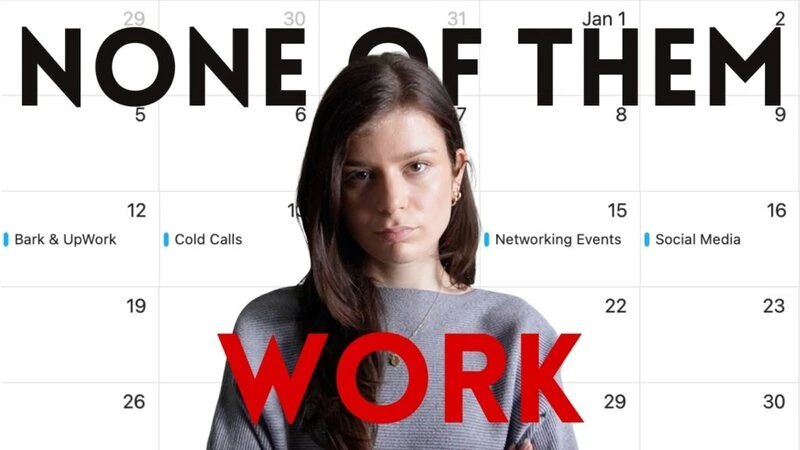
This week on my YouTube Channel, I tried a new Lead Generation method every day, and I’m here to give you a full rundown and the results.
To watch my week day by day, please click here.
What is Lead Generation?
Lead generation is the process of identifying and obtaining potential customers for a business.
Your mind likely goes to cold calling, email marketing or ad campaigns – these are all great strategies! This week, I chose 5:
- Apps (Bark & UpWork)
- Cold Emailing
- Cold Calling
- Networking Events
- Social Media
Here are my findings:
Monday – Apps (Bark & UpWork)
I originally had my reservations about using apps, mainly because of the price. I thought Surely paying for customers defeats the purpose? It’s not just a little money, either. Bark charged me £61.90 for 20 credits, with each listing costing at least 10 credits, some up to 80 EACH! UpWork was a better value by a country mile, coming in at £0.11 per connect (compared to £1.44-£3.10 in Bark).
I began with Bark, scrolling through the endless listings that the app keeps you from forgetting with its constant push notifications. My most obvious observation was the lack of details on the listings. Each job posting gave a brief description of the industry the business operates in, a rough budget (most under £250), and a series of other questions answered with ‘I would like to discuss this with the professional’.
Bark’s vague listings aren’t necessarily a major issue on their own, but when you pair it with the price you must pay to access contact details, it starts to feel like a gamble as to which listing I should spend my money on – they’re all so similar!
The one thing that impressed me about Bark was their Get Hired Guarantee, which states that if you aren’t hired, you get your credits back. There is some online discourse saying that UpWork isn’t very good at keeping its word on this, but if true, I believe that is a great Unique Selling Point UpWork doesn’t have.
After a few complaints and grunts as I browsed, I finally found two listings with a bit more information, so I used my credits to contact them. To my surprise, the first lady called me back within half an hour, and the second man picked up the phone straight away! I immediately helped Client 1 with her website SEO and booked a meeting with Client 2 for Friday. I was dumbfounded! Maybe the money was worth it!
As an update post-Friday, it went great! Bark truly did prove themselves to me.
I moved onto UpWork and was amazed by the significantly stronger buying power. I purchased 100 Connects for $15 (£10.97) and got 40 additional Connects for free, plus another 10 for setting up my profile! I was rolling in 160 Connects, and so I got to work.
The UpWork application process is noticeably trickier and more technical. You don’t gain access to any contact details; rather, you just fill out a form with your skills, experience and relevant projects from your portfolio. Luckily, when you set up your profile, you already fill in a lot of this information, so you can just click a few buttons, but regardless, each listing was taking me over 30 minutes to fill out.
I also noticed UpWork is much more competitive. Bark claims that only 4 people can apply for a listing (though Reddit users argue this is untrue), whereas I saw UpWork listings with 20-50 proposals already sent. Competing with freelancers worldwide does make things a bit trickier, but I also think it’s great that the app gives you the opportunity to show your skills off the bat, and WOW, the listings were detailed.
It’s now been a week, and I’ve got no responses from the 4 people I contacted on UpWork. I did get two of two responses on Bark, though. I still have about 50 Connects left on my Upwork account, so I’ll definitely use them again. As for Bark, I still don’t know if I can justify that price long term, despite the promising results.

2. Tuesday – Cold Emailing
When I started my business, Cold Emails were how I obtained my first few clients. I went locally, using Google Maps to identify small businesses I believed could use my help.
Nowadays, you can automate the process with AI, but I stuck to the old-fashioned way. This meant I sent only 10 emails in an hour and a half. To back myself up, though, I do ensure I take the time to review each email and research competitors, their SEO, and each page of their website to get a comprehensive understanding of the business before reaching out. This way, my emails are more personable and less likely to end up in the Spam folder.
Cold Emailing is a straightforward process, but it can quickly become very repetitive and boring. I know from when I was doing it daily for an hour at a time, it became old rather quickly. This is where I can begin to understand why Automated Emailing Outreach is becoming increasingly appealing and popular.
I ended up getting NO responses. In fairness, I usually follow up over the coming days, but this is realistic nonetheless, as some days you will get no responses, and that’s ok!
3. Wednesday – Cold Calling
Cold calling is infamous for being annoying; I’ve definitely felt that way once or twice before when I’ve been on the receiving end! Conducting yourself in a professional, approachable manner is paramount to success as a cold caller, and there are a few ways in which to do this:
- Have a strong opener
- Be confident and relatable
- Don’t use robotic scripts
- Smile and dial
Don’t procrastinate, just press that green button and make the call!
I had a great time cold calling, which is rare to say. Out of 10 calls, 6 responded and of those 6:
- 2 said yes
- 2 need to be followed up on as they were busy
- 2 kept my details for future reference
Having a 60% response rate and a 0% no-rate is very rare. There have been days when no one picked up the phone, and other days when everyone declined. That is more normal. Two of the leads I contacted were already warm, which obviously played a part in my success, too.
Cold calling has been around for decades and is still going strong, but I don’t doubt that it will begin to fizzle out over the next few years. Whilst it’s effective in getting straight to the point, you have to have a thick skin for those inevitable moments when you’re hung up on or called a rude name.
Also, consider your reputation! The last thing you want as a business owner is to get a bad reputation, especially if you work locally. Make sure you’re confident, to the point and friendly, then you’ll be fine.
Cold calling can also be very repetitive, but this time it’s more obvious in your calls. I promise, potential customers can tell when you’re tired, bored, and just want to go home. If you’re feeling any of those things, put the phone down; it will still be there tomorrow.
4. Thursday – Networking Events
Networking Events are a great way to engage with your local community and get to know like-minded business owners and associates.
Before this experiment, I had been to one before, and had a great time! It is a chance to meet new people, have a laugh, eat some food and get out in the fresh air for a few hours on a Thursday lunchtime. Obviously, all events are different, but Networking Essex‘s are always a good time.
Networking isn’t necessarily a direct Lead Generation technique, and it’s generally frowned upon to spend time simply pitching yourself to everyone in the room. That being said, having fruitful connections in and outside of your industry can be really helpful in many different scenarios.
At the first Networking Event I attended in December, there weren’t many people in my industry, but I still made great connections. On Thursday, there were more people doing websites and social media marketing, but I also found somebody who is a day trader, which is a hobby I am interested in! Whether you find someone directly helpful or not, it’s great people skills.
It’s not what you know, it’s who you know! So, get out there and network.
5. Friday – Social Media
Social media lead generation can be split into inorganic or organic.
Organic Social Media Growth: focuses on putting out high-quality content and building a strong, loyal audience that provides long-term engagement
Inorganic Social Media Growth: uses paid advertising such as Google Ads or LinkedIn Sales Navigator to promote a product or service for rapid engagement and traffic, which usually stops once funding ends.
I spent the day looking into Inorganic Growth, such as LinkedIn Sales Navigator, but for £200 over a 2-day campaign, I was told I would get between 1 and 3 leads. This comes out to £66 per lead, and ironically, I would rather spend that on Bark, where I know there is a stronger guarantee of onboarding those clients.
For my business pages, I plan to pursue organic growth, prioritising high-quality, consistent content to build my audience over time. Obviously, the main downside to this is the time it takes. When I grew an Instagram account to 152,000 followers, it took about 16 months. However, now more than ever, growth can happen overnight with the likes of TikTok, but it usually takes months to years.
The main advantage of social media is that it gives you a strong digital portfolio, where customers can see exactly who you are and what you offer. This helps remove any ambiguity and gets customers to where you want them to go, whether that’s sending you an email or purchasing a product.
Having a good social media presence also improves your credibility and makes you more trustworthy, which is very important for many businesses, especially smaller ones. As trends change, authenticity is sustainable and will help you grow and engage in the long term.
As for inorganic growth, this can be a good short-term fix. The length of an ad campaign can span days, weeks, or months, resulting in high engagement and traffic for a business. The obvious trade-off for this is the price, though. Many small businesses can pay up to £10,000 a MONTH just for Google Ads alone. Whilst this can be effective, it’s important that this is combined with building a strong audience and ensuring you are trusted and reputable.
Another con is that it is social media, which is toxic in itself. No more needs to be said.
I didn’t make any direct social media outreach, so I don’t have any tangible results to share in this post. Regardless, I trust that, over time and with the right strategies, social media can be a great way to promote your business and generate more leads; it’s just not the best option if you’re looking for a quick fix or short-term leads.

Final Thoughts
I had a great time trying these different lead generation techniques! Below is my LEADerboard.
- Networking Events
- Lead Generation Apps
- Social Media
- Cold Calls
- Cold Emails
Each has its own pros and cons and can be useful in its own way, depending on the business using it. It’s important to do your research before jumping into a specific method, as oftentimes running before you can walk can result in losing money, time and energy, all of which are important commodities to have stored in order to funnel them into the perfect strategy for you and your business.
Want to figure out the perfect strategy for your business? Please get in touch.


